The bioethanol industry has, for most of its history, achieved growth by expanding the market for consumer use in cars and trucks. But oil is the source of fuel for many other types of transportation in the U.S. and around the globe. One industry in particular is emerging as a potential opportunity for expanding bioethanol use: marine shipping.
The massive ships that carry goods overseas have traditionally run on bunker oil: thick, sulfur-heavy, tar-like residue left after crude oil is refined. In recent years that industry has recognized the need to change to a cleaner source of fuel, and bioethanol is emerging as one of the most compelling solutions available.
POET has been steadily building relationships with major international shipping companies, sharing the story of bioethanol and its use, availability, environmental benefits, combustion characteristics, and more.
Clearing up misconceptions
“The marine industry wants to, needs to, and in some cases is being forced to decarbonize,” said Doug Berven, POET’s Vice President of Corporate Affairs.
Berven has been involved in discussions with international shipping companies. For a long time, they were turned off of bioethanol due to the false argument that making fuel from crops competes with food supplies. So their first foray into cleaner fuel options was creating dual-fuel engines that could run on green methanol.
But that came with a big problem: supply. There’s just not enough available to make a meaningful difference in fuel emissions.
“And so that brings it full circle to bioethanol, which is the only renewable fuel that’s available, affordable, and clean. Those are three things no other fuel can offer,” Berven said. “After many discussions, they have realized the fact that biofuels enhance world food security due to our feed co-products. They are getting very comfortable with the fact that biofuels fuel and feed the world.”
Market size in the billions of gallons
The scale of the opportunity is enormous. The global shipping industry burns roughly 100 billion gallons of fuel per year. Capturing even one percent of that market would mean one billion new gallons of annual bioethanol demand, said Dustin Dibble, POET’s Commercial Manager, International.
The key technology is the dual-fuel engine. These engines have a tank for bunker oil and an additional tank for clean fuel. Once underway, a ship can toggle between the two tanks as needed.
“It’s like having two gas tanks,” Dibble said. “One with bunker fuel, one with the alcohol. You’re just flipping a switch, and this optionality is very important to an industry dealing with volatility in fuel prices.”
Dibble noted that the additional tanks were originally designed for methanol, but it turns out bioethanol can be used in them with zero modifications. It is a true drop-in fuel. That puts bioethanol in a strategically beneficial position due to its availability.
“That’s been a very appealing factor for the maritime industry. There’s bioethanol in Europe. There’s bioethanol in Asia. There’s bioethanol in South America,” Dibble said. “Ships are moving all around the world, and the vast availability of bioethanol gives the maritime industry confidence in supply assurance.”
Maersk puts bioethanol to the test
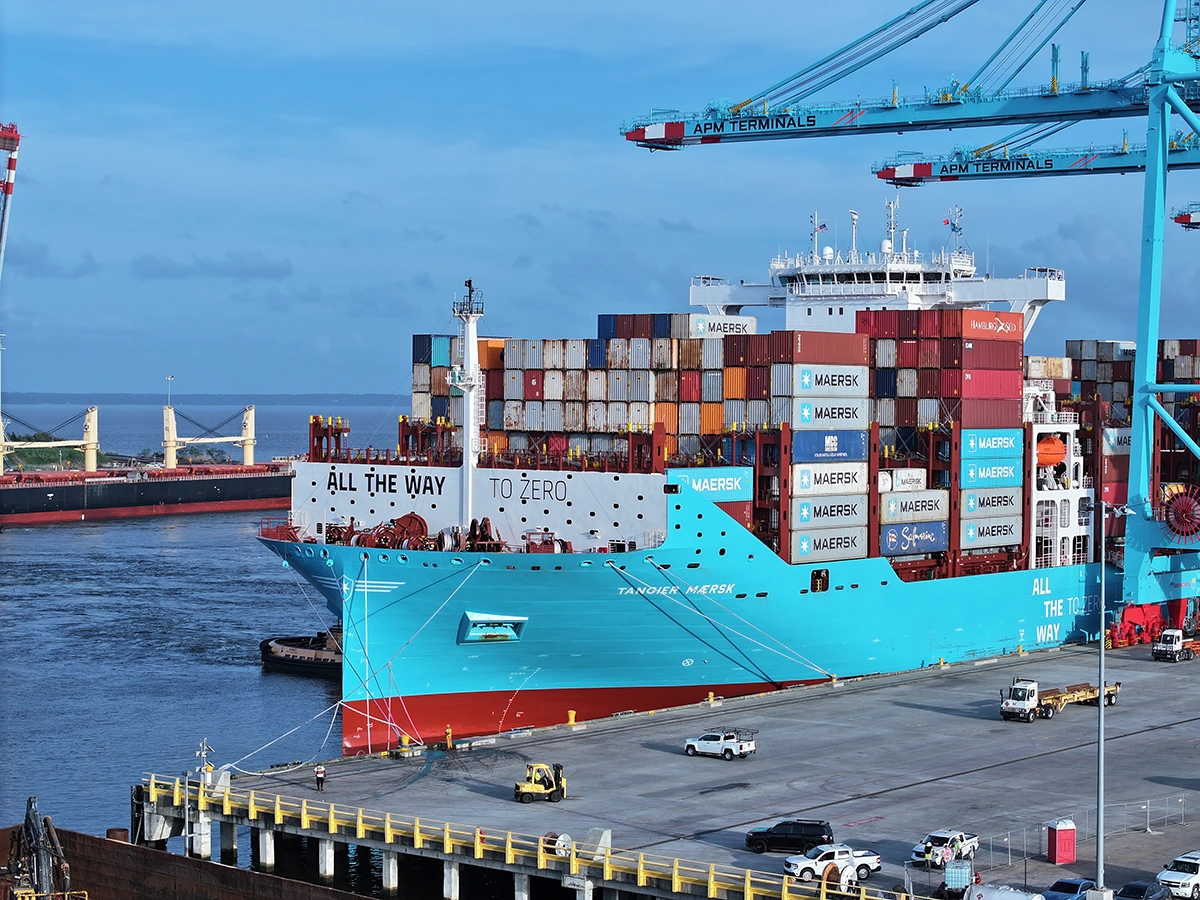
Maersk, one of the world’s largest container shippers, conducted the first 100% bioethanol bunkering operation in the United States in September. The trial took place in Houston using bioethanol supplied by POET.
The company has 24 dual-fuel ships, and it sees potential for bioethanol use in areas that have the strongest supply opportunities.
POET Founder and CEO Jeff Broin said the trial showed what could be an important opportunity to expand bioethanol use worldwide.
“Seeing American-made bioethanol move from the farm to a container ship in one of the nation’s largest ports is an exciting moment for our industry,” Broin said. “Bioethanol is an abundant, affordable, and clean option for the marine sector. It demonstrates what is possible when partners across the value chain work together to open new markets for American agriculture.”
Industry capable of meeting demand
One of the first questions for bioethanol was whether it could overcome the supply issues that other fuels struggled with. With the fuel currently being used primarily in the gasoline market, where would additional gallons come from to meet shipping demands?
Berven is confident bioethanol can meet the needs of new markets like marine shipping.
“Our industry right now could probably produce another two billion gallons without building another plant, not changing anything else in the market,” he said. “So that’s leaving exports where they are and leaving U.S fuel supply where it is.”
Beyond that, the industry is capable of growing along with any new demand, he said.
“As they are ramping up, we will ramp up as well,” Berven said. “Most of our plants and most of the plants in the industry are capable of increasing their capacity if needed. That’s what we’re doing at POET Bioprocessing – Shelbyville right now.”
Feedstock is also not an issue. Berven noted that U.S. corn yields averaged 186.5 bushels per acre last year. As agriculture continues to be more productive, not only can we meet new demand, we need new demand to keep agriculture profitable and provide food, energy, and environmental security for the world. Additionally, the potential for agriculture to provide more feedstock on the same amount of land is an enormous economic opportunity around the world.
Policy tailwinds
The regulatory environment is also in bioethanol’s favor, although some of those moves depend on the politics of the moment.
The International Maritime Organization (IMO) is developing a net-zero framework that would incentivize shippers to adopt lower-carbon fuels, Dibble said. Europe has policies like FuelEU Maritime and carbon pricing as well.
POET works with industry groups and government agencies to position U.S. bioethanol in those international frameworks, Dibble said.
The momentum around bioethanol in marine shipping is building. The infrastructure exists, the supply exists, and the engines are ready. POET has advocated for biofuels to ensure the world’s shippers know the real story, and in response, shippers are taking steps to integrate it into their operations.
From the highway to the high seas, bioethanol is charting a new course.